
Lloyd's Coverholder Reporting: How to Meet CRS 5.2 Requirements in 2026
What is Lloyd's coverholder reporting?
Key Definition: Lloyd's coverholder reporting is the structured submission of premium and claims data from coverholders to Lloyd's managing agents, following the Coverholder Reporting Standards (CRS). Under Lloyd's requirements, coverholders must submit bordereaux data in the specified format, frequency, and quality standards defined by CRS version 5.2.
Definition and Core Concept
Lloyd's coverholder reporting is the formal process by which coverholders submit detailed premium, claims, and risk data to the Lloyd's managing agents who authorize their underwriting activity. A coverholder is an entity authorized by a Lloyd's managing agent to enter into contracts of insurance under a binding authority agreement. The reporting obligation is fundamental to the relationship.
The reporting typically takes the form of bordereaux-detailed schedules of individual risks, premiums, and claims. These submissions must comply with Lloyd's Coverholder Reporting Standards (CRS), which specify the exact data fields, formats, validation rules, and submission timelines. CRS 5.2, introduced in 2021 and mandatory since 2022, is the current version governing these requirements.
The core concept is straightforward: coverholders write business on behalf of Lloyd's syndicates, and those syndicates need granular data to manage their exposure, comply with regulations, and report to Lloyd's Corporation. Without accurate, timely coverholder reporting, managing agents cannot fulfill their own obligations to Lloyd's or regulators.
Why It Matters in the Lloyd's Market
Lloyd's coverholder reporting is not optional-it's a contractual and regulatory requirement. Managing agents face direct consequences if their coverholders fail to report correctly. Lloyd's can suspend or terminate binding authorities. The FCA scrutinizes oversight of coverholders as part of managing agents' Senior Management and Certification Regime (SMCR) responsibilities.
From a practical standpoint, poor reporting creates cascading problems. Managing agents cannot reconcile accounts, leading to delayed or incorrect premium settlements. They cannot accurately assess their exposure or make informed underwriting decisions. Reinsurers demand clean data for their treaties. Regulatory returns to Lloyd's and the FCA require granular data that flows from coverholder submissions.
The financial stakes are significant. A single coverholder might write £50-200 million in premium annually across multiple syndicates. Reporting errors can mean months of reconciliation work, frozen cash flows, and regulatory scrutiny. For coverholders, persistent reporting failures can result in loss of binding authority-effectively ending their Lloyd's business.
Historical Context and Evolution
Lloyd's first introduced formal coverholder reporting standards in the early 2000s. Prior to this, reporting was largely governed by individual binding authority agreements, leading to inconsistent data structures and quality across the market. Managing agents received bordereaux in dozens of different formats, making aggregation and oversight nearly impossible.
The Coverholder Reporting Standards (CRS) emerged to standardize this landscape. CRS 1.0 introduced mandatory field definitions and XML format requirements. Version 2.0 added claims reporting standards. CRS 3.0 and 4.0 refined validation rules and expanded the scope of required data fields.
CRS 5.0, released in 2018, represented a major shift. It introduced stricter data quality requirements, mandatory validation against Lloyd's Data Dictionary, and formalized the concept of "critical errors" that render submissions invalid. CRS 5.2, the current version, added enhanced risk location data, improved claims linking, and tighter controls around premium accounting.
The evolution reflects Lloyd's broader shift toward data-driven oversight. The 2012 Bribery Act enforcement, 2014 Solvency II implementation, and ongoing FCA scrutiny all demand better data from coverholders. Lloyd's cannot meet its own regulatory obligations without clean coverholder reporting.
Current State of the Industry
As of 2026, CRS 5.2 is mandatory for all coverholders with binding authority from Lloyd's managing agents. Most large coverholders have implemented compliant systems, though challenges remain. The market is split between sophisticated operations using modern platforms and smaller coverholders still relying on manual Excel-based processes.
Lloyd's requires quarterly bordereaux submissions for most classes of business, with monthly reporting for high-volume or catastrophe-exposed classes. Submissions must pass automated validation checks before acceptance. Lloyd's Data Submission System (DSS) rejects files with critical errors, forcing resubmission and creating backlogs.
Current compliance rates are mixed. According to Lloyd's performance management data, approximately 75% of coverholder submissions pass validation on first attempt. The remaining 25% require remediation, with an average of 2.3 resubmissions before acceptance. Common failure points include invalid risk codes, missing mandatory fields, and date logic errors.
The market is moving toward real-time or near-real-time reporting. Lloyd's has signaled interest in API-based data submission rather than batch file uploads. Early adopters are already implementing these capabilities, but full market adoption is likely years away. The tension between standardization and the diverse nature of specialty insurance business remains a fundamental challenge.
How It Works: The Technical Foundation
| Field Category | Mandatory Fields | CRS 5.2 Requirement |
|---|---|---|
| Risk Identification | Unique Market Reference (UMR), Policy Number, Section Reference | All fields mandatory for premium records |
| Premium Data | Gross Premium, Brokerage, Net Premium, Premium Currency | Must reconcile; currency codes per ISO 4217 |
| Risk Location | Country Code (ISO 3166-1), Territory Code | Enhanced granularity in CRS 5.2 |
| Temporal Data | Inception Date, Expiry Date, Accounting Period | Must pass date logic validation |
| Claims Data | Claim Number, Loss Date, Paid Amount, Outstanding Reserves | Claims must link to original premium records |
Step-by-Step Process Flow
The coverholder reporting process follows a defined cycle. First, the coverholder writes business under their binding authority. Their policy administration system captures premium, risk, and policy data. At the end of the reporting period (typically quarterly), the coverholder extracts this data and formats it according to CRS 5.2 specifications.
The formatted data undergoes internal validation before submission. Many coverholders use pre-submission validation tools that check against Lloyd's validation rules. This catches obvious errors before formal submission. The validated file is then uploaded to Lloyd's Data Submission System (DSS), typically as an XML or CSV file depending on managing agent requirements.
Lloyd's DSS processes the file through automated validation. Files with critical errors are rejected immediately with an error report detailing each failure. Files passing validation are accepted and forwarded to the managing agent's systems. The managing agent then performs their own reconciliation, matching the bordereaux to their records of written business and cash received.
Any discrepancies trigger a query back to the coverholder. The coverholder investigates, corrects their data, and resubmits if necessary. Once reconciled, the managing agent processes premium settlement. The entire cycle from data extraction to final settlement typically takes 30-90 days for clean submissions, longer if errors require multiple iterations.
Key Components and Their Roles
The coverholder's policy administration system is the primary data source. This system must capture all fields required by CRS 5.2 at the point of policy issuance. Gaps in data capture become expensive problems later. The system needs to track policy amendments, endorsements, cancellations, and returns of premium with full audit trails.
The bordereaux generation engine extracts data from the policy admin system and transforms it into CRS-compliant format. This component handles data mapping, currency conversion if needed, and business logic to derive calculated fields. It must handle complex scenarios like mid-term adjustments, instalment premiums, and multi-year policies.
The validation layer checks data against CRS 5.2 rules before submission. This includes mandatory field checks, data type validation, cross-field logic (e.g., expiry date must be after inception date), and reference data validation against Lloyd's Data Dictionary. Validation rules number in the hundreds for a complete implementation.
The transmission component handles secure file transfer to Lloyd's DSS. This includes authentication, encryption, error handling, and receipt confirmation. Managing agents may also require direct transmission to their own systems in parallel. The system must track submission history, store copies of submitted files, and maintain an audit trail for regulatory purposes.
Data Structure and Format Requirements
CRS 5.2 defines a specific data structure for premium and claims bordereaux. Premium bordereaux contain one record per risk or per instalment of premium, depending on the reporting approach. Each record must include approximately 60-80 fields depending on class of business and whether the risk is original or reinsurance.
The data format is typically XML following the Lloyd's schema definition (XSD), though some managing agents accept delimited text files. XML is preferred because it supports hierarchical structures and embedded validation rules. The schema strictly defines field lengths, data types, and allowed values. For example, the Country Code field must be exactly 2 characters, matching ISO 3166-1 alpha-2 codes.
Claims bordereaux have a separate but related structure. Each claim record must link back to the original premium record via UMR and policy identifiers. Claims reporting includes paid amounts, case reserves, IBNR allocations, and recoveries. Movement reporting shows changes since the last submission rather than cumulative positions.
Lloyd's requires specific file naming conventions. Files must include the coverholder code, managing agent code, syndicate number, period reference, and submission sequence number. Incorrect naming can cause rejection before validation even runs. The technical specification document for CRS 5.2 is over 200 pages, reflecting the complexity of these requirements.
Integration Points and Standards
Lloyd's DSS is the primary integration point. Coverholders must authenticate using credentials provided by the managing agent. The DSS API supports both batch file upload and, increasingly, record-by-record API submission. Response codes indicate acceptance, rejection, or warnings that require attention but don't block processing.
Managing agents often operate their own systems in parallel to Lloyd's DSS. A coverholder with authorities from five different managing agents may need to submit to six different systems (Lloyd's plus each agent's platform). Data requirements are similar but not identical. Some agents impose additional validation rules or require supplementary data beyond CRS 5.2 minimums.
Industry platforms like CLASS (the centralized Lloyd's accounting and settlement system) consume validated bordereaux data. Premium and claims flow through CLASS for cash settlement between coverholders, brokers, managing agents, and syndicates. Errors in bordereaux data can create cash breaks that lock up millions in disputed settlements.
Standards compliance extends beyond CRS 5.2. Coverholders must use Lloyd's Data Dictionary for reference data like class of business codes, currency codes, and territory codes. They must follow Lloyd's catastrophe event naming conventions if reporting cat losses. They must adhere to Lloyd's Market Reform Contract reforms for contract certainty. These standards interconnect-non-compliance in one area often cascades into reporting failures.
Common Challenges and Pain Points
Real Example: A mid-sized MGA writing marine cargo business submitted their Q4 2025 bordereaux on January 15, 2026. Lloyd's DSS rejected the file with 247 critical errors-primarily invalid country codes and missing UMRs. After correction and resubmission (January 29), reconciliation with the managing agent revealed a £1.2M discrepancy in reported premium. The final reconciliation completed March 18, delaying cash settlement by 62 days and requiring 140 hours of analyst time to resolve.
Manual Processing Bottlenecks
Many coverholders still rely on manual Excel-based processes to prepare bordereaux. Analysts extract data from the policy admin system, manipulate it in spreadsheets, and manually format it for CRS 5.2 compliance. This approach works for small portfolios but breaks down at scale.
The manual workflow creates serial bottlenecks. One person extracts data, another validates it, a third formats it, and a fourth submits it. Any error discovered late in the process forces the entire chain to restart. During peak periods (quarter-end, year-end), teams work overtime to meet submission deadlines.
Formula errors in Excel are common and difficult to detect. A single incorrect cell reference can propagate through thousands of rows. Manual data entry introduces typos-particularly in fields like UMR or policy numbers where small errors render records invalid. Copy-paste errors create duplicate records or mis-aligned data.
Coverholders processing multiple binding authorities face exponential complexity. Each authority may have different data requirements, reporting frequencies, and managing agent specifications. Maintaining separate Excel templates for each becomes unsustainable. The manual approach simply doesn't scale to the volume and complexity of modern specialty insurance.
Data Quality and Validation Issues
Data quality failures are the primary cause of bordereaux rejection. Lloyd's CRS 5.2 validation rules are strict and unforgiving. A single critical error in a file containing 10,000 risk records causes rejection of the entire file. Common errors include invalid reference codes, failed date logic checks, and missing mandatory fields.
The root cause often lies upstream in the policy admin system. If the system doesn't capture the Territory Code at point of sale, that data gap becomes a bordereaux error months later. Retrofitting missing data is expensive and often impossible without contacting the original broker or insured.
Cross-field validation catches many submissions. For example, if Country Code is "US" but Territory Code indicates a European location, validation fails. If Expiry Date precedes Inception Date, validation fails. If Premium Currency is GBP but amounts contain dollar signs, validation fails. These logic checks are necessary but create friction when source data is messy.
Legacy systems compound the problem. Many coverholders operate policy admin platforms built in the 1990s or early 2000s. These systems predate CRS requirements and lack the data fields Lloyd's now demands. Bridging this gap requires complex data mapping, inferred values, and sometimes manual data enrichment-all introducing error risk.
Regulatory Compliance Requirements
Lloyd's coverholder requirements extend beyond technical data standards into regulatory compliance. Managing agents must demonstrate effective oversight of their coverholders under the FCA's SMCR framework. Poor bordereaux quality is evidence of weak oversight, attracting regulatory scrutiny.
Lloyd's can audit any coverholder's submissions at any time. Persistent quality failures trigger remediation plans, which may include enhanced reporting, third-party audits, or restrictions on new business. Severe cases result in suspension or termination of binding authority-a career-ending outcome for many MGAs.
The FCA expects managing agents to have documented processes for coverholder oversight, including bordereaux validation, reconciliation procedures, and escalation protocols. Agents must demonstrate they're actively monitoring coverholder performance. Bordereaux submission history becomes evidence in regulatory examinations.
Solvency II adds another layer. Lloyd's must aggregate exposure data across all syndicates for regulatory capital calculations. This aggregation depends on clean, consistent coverholder data. Errors in risk location, policy limits, or exposure accumulation compromise Lloyd's ability to meet its own Solvency II reporting obligations. The regulatory pressure flows downhill to coverholders.
Time and Cost Impact Analysis
The financial impact of poor bordereaux quality is substantial. Consider a coverholder writing £100M in annual premium across three managing agents. Clean bordereaux processing requires approximately 0.5 FTE for quarterly submissions-roughly £30,000 annually in labor cost.
Now consider the same coverholder with persistent quality issues. Rejection rates above 40%. Multiple resubmission cycles. Extensive reconciliation required. This scenario easily requires 2.0 FTE-£120,000 annually, a 4x increase. Add delayed cash settlement (£100M premium delayed 60 days costs approximately £500,000 in opportunity cost at 3% interest), and the total impact exceeds £600,000 annually.
Managing agents pass costs back to coverholders. Some agents now charge resubmission fees (£500-2,000 per rejected file) or enhanced oversight fees for persistently non-compliant coverholders (£10,000-50,000 annually). These fees are contractual and non-negotiable.
Time impact extends beyond finance teams. Operations staff spend time extracting missing data. IT teams maintain fragile integration between policy systems and bordereaux generators. Senior management time is consumed explaining quality failures to managing agents. The cumulative organizational drag is difficult to quantify but substantial.
Real-World Examples
A specialist cyber MGA implemented CRS 5.2 compliant systems in early 2023. Despite significant investment, their first year saw 35% rejection rates. The root cause: their policy admin system used free-text fields for risk locations, which couldn't be mapped reliably to ISO country codes. They ultimately rebuilt their risk entry screens, adding structured location data capture. The remediation cost £180,000 and took 14 months.
A marine hull coverholder with 40 years of Lloyd's market history nearly lost their binding authority in 2024. Their legacy underwriting system, built in-house in 1998, couldn't generate several CRS 5.2 mandatory fields. They were manually populating these fields in Excel for each submission. An audit by their managing agent revealed over 2,000 records with incorrect or fabricated data. The managing agent imposed a 6-month remediation plan with monthly audits.
Conversely, a property cat MGA invested in automated bordereaux generation in 2022, before CRS 5.2 became mandatory. Their first-submission pass rate exceeded 95% immediately. They process quarterly bordereaux with 0.3 FTE. Their managing agents cite them as an exemplary coverholder. They've secured three new binding authorities based partially on their operational excellence in reporting.
Implementation Best Practices
Common Pitfalls to Avoid:
- Starting too late: Beginning implementation 30 days before go-live guarantees failure. Allow 4-6 months minimum.
- Underestimating data gaps: Assume your policy admin system is missing 20-30% of required CRS fields until proven otherwise.
- Skipping parallel testing: Running new system in parallel with old processes for at least one full quarter catches integration issues.
- Insufficient managing agent engagement: Get your managing agents involved early-they'll spot issues you miss.
- Ignoring historical data: You'll need to submit amendments to prior periods. Ensure your system can handle historical data.
Assessment and Planning Phase
Begin with a comprehensive data gap analysis. Extract sample data from your policy admin system and compare it against CRS 5.2 field requirements. Catalog every missing, incomplete, or incorrectly formatted field. This analysis typically reveals gaps in 25-40% of required fields for coverholders who haven't systematically addressed CRS compliance.
Engage managing agents early. Share your implementation plan and timeline. Ask for sample bordereaux files from compliant coverholders they work with. Request access to their test environments for submission validation. Managing agents want your implementation to succeed-leverage their expertise and willingness to help.
Define a realistic timeline. For mid-sized coverholders, plan 4-6 months from project kickoff to first production submission. Large coverholders with complex portfolios may need 9-12 months. Timelines typically break down as: 4-6 weeks for data analysis, 8-12 weeks for system configuration, 4-6 weeks for testing, 2-4 weeks for training and parallel running.
Allocate resources appropriately. You'll need technical resources for integration work, operations staff who understand policy data, finance staff who handle reconciliation, and project management to coordinate. Underestimating resource requirements is a primary cause of implementation delays.
Data Preparation and Migration
Fix upstream data capture first. Modifying underwriting screens to capture required CRS fields at point of sale prevents data gaps from occurring. This might mean adding dropdown fields for territory codes, implementing structured location data entry, or enforcing UMR format standards. These changes pay dividends immediately.
Develop data enrichment rules for historical policies. You'll need to submit bordereaux for in-force policies that were written before your new system went live. Rules might infer missing territory codes from post codes, derive risk categories from policy descriptions, or apply default values based on business logic. Document these rules carefully-auditors will ask about them.
Cleanse reference data proactively. Extract all unique values for fields like class of business, territory, currency code. Map them to Lloyd's Data Dictionary codes. Correct any misalignments in your source systems. This one-time cleanup effort prevents thousands of validation errors down the line.
Plan for data migration carefully if changing systems. Historical submission data, reconciliation records, and audit trails must carry forward. Define retention policies-Lloyd's requires 7 years of bordereaux history for audit purposes. Test migration thoroughly; data migration failures have derailed numerous implementations.
System Integration Strategy
Prioritize API integration over flat file exchange. Modern policy admin systems typically offer APIs for data extraction. Use these rather than database queries or file exports. APIs provide cleaner data contracts and better error handling. If your policy admin vendor doesn't offer suitable APIs, consider whether it's time to migrate platforms.
Implement real-time validation at data entry. Integrating Lloyd's validation rules into underwriting workflows catches errors immediately. An underwriter entering an invalid country code sees instant feedback. This "shift left" approach-catching errors earlier in the process-is far more efficient than discovering them at submission time.
Build for bidirectional data flow. Your integration should not only send bordereaux data outbound, but also receive validation results, reconciliation exceptions, and settlement confirmations inbound. This closed-loop integration enables automated exception handling and reduces manual reconciliation effort.
Consider master data management. If you submit to multiple managing agents with slightly different requirements, a central MDM repository can maintain mappings and transformations. This prevents proliferation of point-to-point integrations and simplifies ongoing maintenance.
Testing and Validation
Start testing with historical data. Take last quarter's actual premium and claims data, process it through your new system, and compare output to what you actually submitted. Differences indicate configuration problems or data transformation errors. Historical testing is safe-you're not risking real submissions.
Use Lloyd's test environments. Lloyd's DSS provides test submission capabilities. Submit sample files and verify they pass validation. Test with both clean data and deliberately incorrect data to confirm your validation logic matches Lloyd's. Some managing agents also offer test environments-use them.
Run parallel processes for a full quarter. Continue your old process while running the new system in parallel. Compare outputs in detail. Investigate any discrepancies. This parallel running provides confidence before cutting over completely. It also provides a fallback if the new system has unexpected issues.
Test edge cases exhaustively. Mid-term adjustments, cancellations, returns of premium, multi-year policies, instalment premium accounting, cross-border risks, reinsurance treaties-make sure your system handles all scenarios you encounter in practice. Edge cases are where implementations fail in production.
Training and Change Management
Train underwriters on new data entry requirements. If you're implementing real-time validation or adding new mandatory fields, underwriters must understand why and how to comply. Frame this as "protecting our binding authority" rather than additional bureaucracy. Show them the cost of poor data quality.
Train operations staff thoroughly. They'll be running the new bordereaux process. Walk through complete end-to-end workflows. Provide written procedures. Conduct mock quarterly submissions as training exercises. Identify knowledge gaps and address them before production cutover.
Prepare finance and management for process changes. Settlement timing may shift. Reconciliation workflows will change. Reporting will look different. Get stakeholder buy-in for these changes early. Resistance from finance teams has derailed several implementations despite technical success.
Plan for ongoing training. Staff turnover means new hires need training. System updates require retraining. Lloyd's periodically updates CRS requirements, necessitating process changes. Budget for continuous training, not just initial implementation training.
Measuring Success and KPIs
Track first-submission pass rate as your primary quality metric. Industry leaders achieve 95%+ first-time validation success. Emerging performers sit at 80-90%. Below 70% indicates serious quality problems. Calculate this monthly and trend it over time. Share results with managing agents-they notice and appreciate transparency.
Measure cycle time from data extraction to submission acceptance. Best-in-class coverholders complete this in under 5 business days. Average performers need 15-20 days. Slow cycle times indicate inefficiency or quality issues. Break down cycle time by subprocess to identify bottlenecks.
Monitor reconciliation effort. How many FTE-hours does each quarterly submission require? Track this before and after implementation to demonstrate ROI. Also track reconciliation exceptions-unmatched premiums, unexplained differences, query volumes from managing agents.
Track cash settlement timing. How many days from submission to cash settlement? Faster settlement improves working capital. A 30-day improvement on £100M annual premium releases approximately £250,000 in working capital. This metric demonstrates tangible financial benefit to your CFO.
Regulatory and Compliance Considerations
| Requirement | Standard/Regulation | Consequence of Non-Compliance |
|---|---|---|
| Quarterly Bordereaux Submission | CRS 5.2, Binding Authority Agreement | Managing agent may suspend new business; repeated failures lead to termination |
| Monthly Submission (High-Risk Classes) | Lloyd's Requirements, Managing Agent Terms | Immediate escalation to Lloyd's oversight; potential authority restriction |
| CRS 5.2 Technical Compliance | Lloyd's Coverholder Reporting Standards v5.2 | Rejection of submissions; resubmission delays settlement by 30-60 days |
| Data Retention (7 Years) | Lloyd's Record Keeping Requirements, FCA SYSC | Regulatory sanctions; inability to defend regulatory examinations |
| Adequate Oversight Systems | FCA SMCR, Lloyd's Oversight Standards | Managing agent personal liability; potential prohibition orders |
| GDPR Compliance | UK GDPR, Data Protection Act 2018 | ICO fines up to £17.5M or 4% of global turnover; individual rights claims |
Lloyd's Requirements and Standards
Lloyd's Coverholder Reporting Standards (CRS) version 5.2 represent the minimum mandatory requirements for all coverholders operating under binding authorities. The standards specify 147 distinct data fields across premium and claims bordereaux, with 63 classified as mandatory and the remainder conditional based on class of business. Non-compliance is not a trivial administrative matter-it constitutes a material breach of the binding authority agreement.
The binding authority agreement itself incorporates CRS 5.2 by reference, making compliance a contractual obligation rather than merely a best practice. Persistent failures to meet submission deadlines or quality standards trigger formal remediation procedures. Lloyd's three-stage escalation process begins with informal notification, progresses to formal warning with remediation plan requirements, and culminates in suspension or termination of the binding authority.
Lloyd's maintains a Coverholder Performance Management framework that tracks submission timeliness, validation pass rates, and reconciliation cycles for every coverholder. Managing agents receive quarterly scorecards showing their coverholders' performance relative to market averages. Coverholders in the bottom quartile attract enhanced scrutiny. Those in the bottom decile face intervention.
The standards extend beyond data submission to encompass systems and controls. Lloyd's expects coverholders to maintain adequate IT infrastructure, documented procedures for bordereaux preparation, segregation of duties between data preparation and submission, and management oversight of submission quality. These operational requirements appear in Lloyd's Minimum Standards guidance, which managing agents must enforce as part of their oversight obligations.
FCA Oversight and Expectations
The Financial Conduct Authority's Senior Managers and Certification Regime (SMCR) places personal accountability on managing agents' senior management for oversight of delegated authorities. The FCA considers ineffective coverholder oversight to be a failure of systems and controls under SYSC 4.1. Bordereaux quality serves as tangible evidence of oversight effectiveness.
During supervisory reviews, the FCA examines managing agents' coverholder oversight frameworks. They request bordereaux submission logs, validation exception reports, and evidence of remediation where problems occurred. They interview senior managers responsible for delegated authority oversight. Poor bordereaux compliance by a managing agent's coverholder panel indicates weak oversight, potentially triggering regulatory action against the managing agent.
The FCA's expectations are documented in their Delegated Authority Thematic Review (2019) and subsequent Dear CEO letters. They expect managing agents to maintain comprehensive oversight frameworks including pre-binding due diligence, ongoing monitoring of bordereaux quality, regular on-site visits to coverholders, and formal escalation procedures when standards slip. The expectation is active oversight, not passive receipt of bordereaux.
Regulatory consequences extend beyond managing agents to coverholders directly. Coverholders authorised by the FCA face direct supervision. The FCA can and has imposed requirements on individual coverholders to improve their bordereaux processes. In extreme cases involving persistent non-compliance coupled with poor governance, the FCA has prohibited individuals from performing controlled functions. The regulatory risk is real and material.
Data Protection and GDPR
Bordereaux contain personal data when risks insure individuals rather than purely commercial entities. Policy numbers, named insureds, loss locations, and claim details all potentially constitute personal data under UK GDPR. Coverholders act as data controllers; managing agents as either controllers or processors depending on the nature of their relationship. Both bear compliance obligations.
The legal basis for processing personal data in bordereaux is typically contractual necessity or legitimate interests. The binding authority contract requires premium and claims reporting, establishing contractual necessity. Managing agents have legitimate interests in receiving data necessary to manage their underwriting exposure and meet their own regulatory obligations. However, these bases do not eliminate the requirement to process data fairly, transparently, and securely.
Data retention presents particular challenges. Lloyd's requires seven years of bordereaux records for audit purposes. UK GDPR Article 5(1)(e) requires data to be kept no longer than necessary. The ICO acknowledges that regulatory retention requirements constitute a lawful basis for extended retention, but only if the coverholder can demonstrate the regulatory requirement is genuine and the retention period is proportionate.
Cross-border data transfers add complexity. Coverholders submitting bordereaux containing personal data to managing agents in other jurisdictions must ensure adequate transfer mechanisms. Standard contractual clauses typically cover Lloyd's market transfers given the prevalence of managing agents in the UK, the EU, and Bermuda. However, post-Brexit, coverholders must navigate the UK GDPR separately from EU GDPR where both jurisdictions' data subjects appear in their portfolio.
Audit Trail and Documentation
Lloyd's requires coverholders to maintain complete audit trails for all bordereaux submissions. This encompasses submitted files, validation reports, rejection notices, resubmission records, reconciliation documentation, and settlement confirmations. The audit trail must enable reconstruction of every submission and every correction made throughout the seven-year retention period.
System-generated audit logs must capture who extracted data, when transformations were applied, what validation checks ran, who approved submissions, and who uploaded files to Lloyd's DSS. Manual interventions require particular documentation-if an analyst manually corrects a data field before submission, that correction must be logged with timestamp, user identity, original value, corrected value, and reason for correction.
Managing agents conduct periodic audits of their coverholders' bordereaux processes. These audits examine both submitted data and the systems and controls producing that data. Auditors review policies end-to-end from original placement documentation through to bordereaux records, verifying completeness and accuracy. They test system configurations, validation rules, and data transformation logic. They assess whether documented procedures reflect actual practice.
Lloyd's Corporation reserves the right to audit any coverholder's submissions and underlying systems. In practice, Lloyd's conducts approximately 50-80 coverholder audits annually, targeting either poor performers or randomly selected entities as part of market oversight. These audits are thorough, typically involving multiple auditors on-site for 3-5 days. Findings feed into Lloyd's assessment of whether the coverholder should retain its binding authority status. Documentation inadequacies feature prominently in adverse audit findings.
Future Trends and Industry Direction
Automated Data Processing Advances
Lloyd's Blueprint Two initiative, launched in 2024, explicitly encourages the adoption of modern automation across market processes including bordereaux processing. Automated systems can now predict likely validation failures before submission, analyse historical patterns to detect anomalous premium or claims data, and automatically suggest corrections for common data quality issues.
Modern data processing has reached sufficient maturity to extract structured data from unstructured sources. When a coverholder's legacy system stores risk location as free text ("Warehouse on Industrial Estate, Slough"), automated parsing can extract the correct ISO country code (GB), territory code, and potentially even coordinates. This capability bridges the gap between old systems and modern reporting requirements without manual intervention.
Anomaly detection identifies outlier records that warrant human review. If a coverholder typically writes motor fleet policies with average premiums of £15,000, a record showing £150 premium triggers automatic flagging. These systems learn normal patterns from historical submissions and flag deviations. They catch data entry errors that would otherwise pass validation but represent genuine mistakes.
Lloyd's and the FCA both require explainability for material business decisions. Automated systems that correct data must provide auditable explanations for corrections. This explainability requirement means simple, transparent models often outperform complex approaches despite lower raw accuracy. The regulatory environment shapes technology adoption as much as technical capability does.
API-First and Real-Time Processing
Lloyd's Data Submission System (DSS) now supports API-based submission alongside traditional batch file uploads. The API enables record-by-record submission with immediate validation response. Coverholders can submit premium records the same day policies are bound rather than accumulating data for quarterly batch submission. This shift from batch to streaming represents a fundamental architectural change in market data flows.
Real-time submission enables real-time exposure management. Managing agents can monitor their catastrophe exposure daily rather than quarterly. They can identify accumulation risks as they emerge rather than discovering them months later when bordereaux finally arrive. For catastrophe-exposed classes, this timing difference materially improves risk management.
The London Market Target Operating Model (TOM), which aims to achieve same-day policy placement-to-cash, depends on real-time bordereaux data. Current quarterly submission cycles create 90-day lags incompatible with same-day settlement. The TOM explicitly requires coverholders to submit premium data within 24 hours of binding. This requirement will necessitate API-based integration for most coverholders.
Adoption rates remain modest. As of mid-2026, approximately 15-20% of coverholders submit via API, with the remainder using batch files. The barriers are integration costs and technical complexity, not API availability. Lloyd's has indicated that batch file submission will remain supported indefinitely, acknowledging the reality that mandating API submission would force smaller coverholders from the market. However, the commercial advantage of real-time processing-faster cash settlement, better exposure management, stronger relationships with managing agents-increasingly favours early adopters.
Industry Standardisation Efforts
The ACORD/AL3 data standards initiative seeks to harmonise bordereaux requirements across the global specialty insurance market. Currently, a coverholder writing business for Lloyd's syndicates, European insurers, and Bermudan reinsurers faces three distinct reporting standards with substantial but imperfect overlap. ACORD/AL3 aims to establish a common data model that satisfies all three.
Practical adoption lags ambition. ACORD has published data model specifications, but implementation by managing agents and coverholders remains patchy. The problem is path dependency-coverholders have invested in CRS 5.2 compliant systems, managing agents have built processing infrastructure around Lloyd's formats, and the cost of migration to new standards appears prohibitive absent regulatory mandate.
Lloyd's participation in standardisation efforts is measured. They acknowledge the theoretical benefits of global standards but remain protective of CRS as fit-for-purpose for the Lloyd's market. The nuances of Lloyd's operation-subscription markets, unique risk codes, syndicate accounting peculiarities-create legitimate requirements that generic global standards struggle to accommodate. Lloyd's appears willing to converge where practical but not to sacrifice Lloyd's-specific requirements for the sake of standardisation.
The most realistic near-term outcome is multilingual translation rather than wholesale replacement. Coverholders maintain their CRS 5.2 compliant bordereaux but systems translate these to ACORD/AL3 for non-Lloyd's placements. Several bordereaux platforms now offer this capability, recognising that coverholders operate across multiple markets and need to satisfy multiple standards. This approach preserves existing investments whilst enabling participation in standardisation efforts where beneficial.
What This Means for Your Business
Coverholder reporting requirements will not simplify. The trajectory is toward more frequent submission, higher data quality expectations, and broader scope of reported data. Lloyd's December 2025 consultation paper on CRS 6.0 proposes adding detailed exposure location coordinates, enhanced reinsurance data, and ESG-related risk characteristics. The data burden grows as regulatory and commercial demands evolve.
Technical investment becomes non-discretionary. Coverholders cannot credibly operate in the Lloyd's market medium-term without systematic bordereaux processes. Excel-based manual workflows are already strained beyond sustainability for most. The upcoming shift toward real-time, API-based submission will render manual processes completely unworkable. Investment in proper systems is not an efficiency opportunity-it is a condition of continued market participation.
The competitive landscape changes. Managing agents increasingly favour coverholders who demonstrate operational excellence through clean, timely bordereaux submission. Binding authorities are valuable-agents allocate them to coverholders who minimise operational friction. Poor bordereaux performance now factors into renewal discussions. Several managing agents have explicitly linked coverholder commission rates to bordereaux quality metrics, creating direct financial incentives for compliance.
For coverholders contemplating entry to the Lloyd's market, bordereaux capability should feature in business planning from inception. Attempting to bolt on compliant reporting after establishing a book of business is expensive and disruptive. The most successful new market entrants in recent years launched with automated, CRS-compliant systems from day one. This front-loaded investment produces competitive advantage that compounds over time through superior managing agent relationships and operational efficiency.
Conclusion and Next Steps
Key Takeaways
Lloyd's coverholder reporting under CRS 5.2 represents a non-negotiable operational requirement with material consequences for non-compliance. The standards specify 147 data fields, impose strict validation rules, and demand quarterly (or monthly) submission to precise technical specifications. Approximately 25% of submissions still fail initial validation, triggering costly remediation cycles that delay cash settlement and strain managing agent relationships.
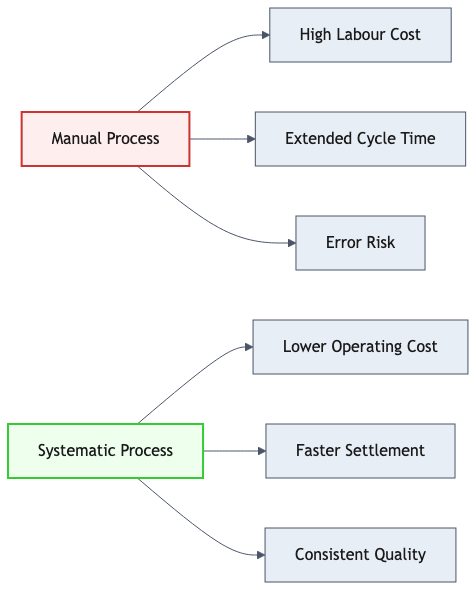
The financial impact of poor bordereaux quality extends beyond direct labour costs to encompass delayed cash settlement, managing agent penalty fees, and opportunity cost from diverted resources. A coverholder writing £100M annual premium with chronic quality issues can easily incur £500,000-600,000 in annual costs. The cost differential between manual and systematic approaches is not marginal-it is order-of-magnitude.
Regulatory risk compounds financial risk. The FCA explicitly considers bordereaux quality as evidence of managing agent oversight effectiveness under SMCR. Lloyd's maintains performance scorecards for every coverholder and intervenes where submission quality or timeliness falls below acceptable thresholds. Persistent non-compliance leads to binding authority suspension or termination, ending the coverholder's Lloyd's business.
The industry trajectory points toward increased automation, real-time submission via APIs, and higher data quality expectations. CRS 6.0 proposes expanding required data fields. The London Market Target Operating Model demands 24-hour submission cycles. Manual, Excel-based bordereaux processes cannot survive this evolution. Investment in systematic bordereaux capabilities transitions from operational improvement to existential necessity.
The competitive dimension matters increasingly. Managing agents favour coverholders who deliver clean, timely bordereaux. Several agents now explicitly link commission rates to bordereaux quality metrics. As binding authorities become more selective and concentrated, operational excellence in reporting becomes a competitive differentiator. The best coverholders view bordereaux capability as strategic advantage rather than compliance burden.
Looking Ahead
Lloyd's coverholder reporting requirements will continue evolving. CRS 6.0 consultation is already underway. Real-time submission will become standard. ESG data will enter reporting requirements. The gap between manual processes and regulatory expectations widens each year.
Coverholders currently operating manual bordereaux processes face a strategic decision. The operational burden of spreadsheet-based workflows grows as submission frequency increases and validation rules tighten. Data gap analysis typically reveals missing or incorrect fields in 20-40% of required CRS data for coverholders who haven't systematically addressed compliance.
The London Market Target Operating Model envisions 24-hour submission cycles. Lloyd's Data Submission System already supports API-based submission. Managing agents increasingly expect real-time data flows. These shifts make systematic bordereaux processing capabilities essential rather than optional for serious market participants.
BDXML processes bordereaux automatically - running validation rules, checking CRS 5.2 compliance, and surfacing analytics on your data. Get in touch to discuss your bordereaux processing needs.