
What Clean Data Actually Costs
An organisation receives bordereaux from five coverholders. Manageable. Each has different format, someone maps them manually, work gets done.
Same organisation grows to thirty coverholders. Same approach. Problem is the cost doesn't grow linearly - it compounds.
The scaling problem
Five coverholders: five sets of mapping logic. Thirty coverholders: thirty sets of mapping logic.
Each coverholder needs:
- Column mapping ("Insured_Name" → standard field, "Named Insured" → same field, "Policyholder" → same field)
- Date format handling (DD/MM/YYYY vs MM/DD/YYYY vs YYYY-MM-DD)
- Premium structure reconciliation (different breakdowns, different field names)
- Validation rules specific to that coverholder's quirks
Same transformation logic, written thirty times. Each coverholder changes format occasionally. All mappings need updating. × 12 months.
The work doesn't just accumulate. It multiplies.
Why it compounds
Maintenance burden. Coverholder A changes format in March. Mapping breaks. Someone investigates, fixes it. Coverholder B changes in June. Same process. Coverholder C in September. Multiply by thirty coverholders.
Repetitive pattern matching. Same problem solved thirty times. "This column with uppercase strings starting with POL is probably policy reference" - identical logic, implemented manually for each coverholder.
Expertise misuse. Skilled people doing repetitive transformation work instead of analysis. The person who understands insurance data spending hours on format conversions.
The cost isn't just time. It's skilled time doing unskilled work, repeatedly.
Where it breaks
At five coverholders, thorough processing is achievable. At thirty coverholders, it isn't.
Organisations face impossible tradeoff: process thoroughly (unsustainable time requirement) or process quickly (known accuracy gaps).
Most choose the gap. "Good enough" becomes the standard because "fully accurate" is unachievable at scale with manual transformation.
What changes the cost structure
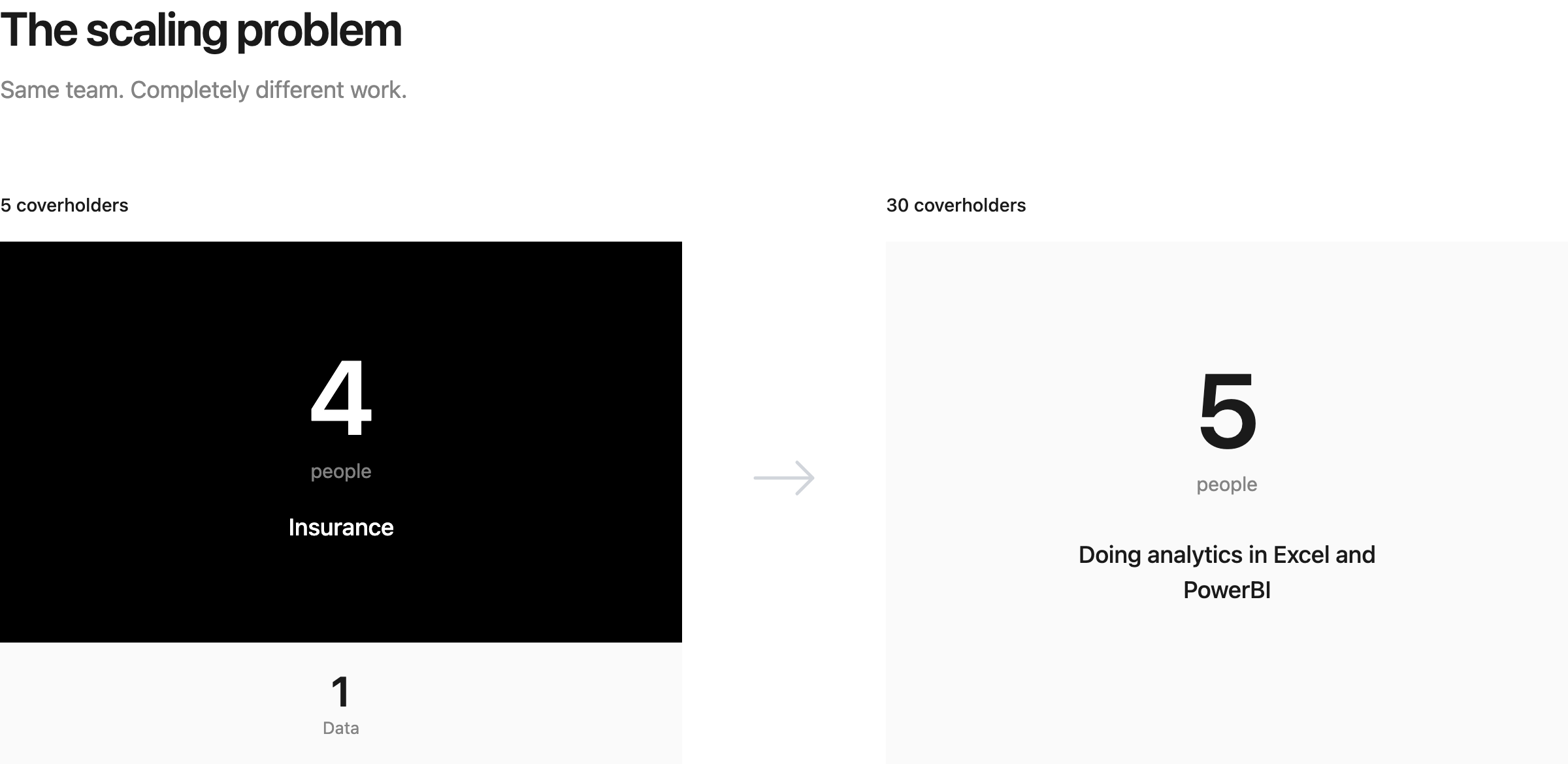
Manual approach: team composition shifts entirely. Five coverholders: one person normalising, four people analysing. Thirty coverholders: five people normalising, zero people analysing.
The problem isn't just cost. It's that skilled insurance professionals spend all their time on data transformation instead of risk assessment.
The alternative: automation handles normalisation. BDXML learns patterns from the first five coverholders, applies them to the next thirty automatically. Infers missing details, spots anomalies, surfaces insights - without building PowerBI dashboards or endless back-and-forth with actuaries.
Same team size. Everyone doing insurance work, nobody stuck in spreadsheets.
Manual approach scales by hiring. Automated approach doesn't scale at all - it's the same effort at five coverholders and thirty.
BDXML automates bordereaux normalisation and analysis. Learn more about what a bordereau is and how automation applies to insurance.